Uniform Mitigation Verification Inspection Form OIR-B1-1802 (Rev. 04/26) Adopted by Rule 69O-170.0155, F.A.C. Page 4 & 5 – Section 9 — Opening Protection (Part 2 of 2): Classification Details
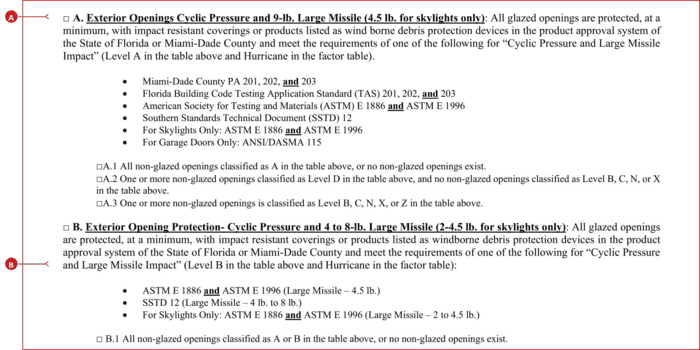
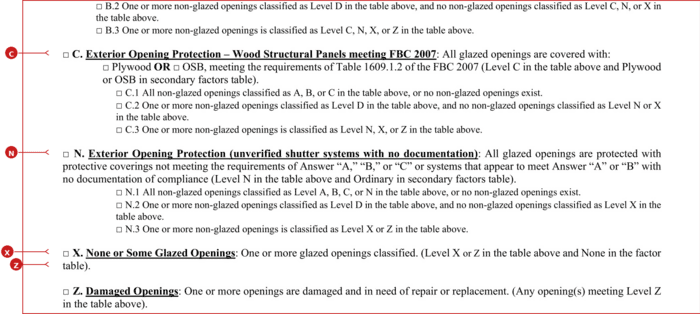
Note: The classification details for Section 9 span two pages of the form. The first image above covers Answer A and the beginning of Answer B. The second image picks up with the remainder of B and continues through C, N, X, and Z.
Section 9 — Opening Protection (Part 2 of 2): Classification Details
The previous page introduced the Opening Protection Level Chart and its row and column structure. This page explains the detailed written definitions that determine what qualifies for each protection level. Each answer represents a specific standard that the opening protection products must meet — and for most answers, there are sub-classifications based on how the non-glazed openings on the same home relate to the glazed opening rating.
Understanding the Sub-Classifications (.1, .2, .3)
Each main answer — A, B, C, and N — contains three sub-options labeled .1, .2, and .3. These sub-classifications address the relationship between glazed openings and non-glazed openings on the same structure. The glazed openings determine which main answer letter is selected. The sub-option then refines the answer based on what is happening with the non-glazed openings — primarily the solid entry doors and garage doors. The sub-option does not change the main credit level but provides a more complete picture of the structure’s overall protection status.
Answer A — Highest Protection: Cyclic Pressure and 9-lb. Large Missile Impact
- To qualify for Answer A, all glazed openings on the home must be protected with impact-resistant products that are listed in the Florida or Miami-Dade County product approval system and have been tested and verified to withstand both cyclic pressure and large missile impact. For windows and entry doors, the large missile test uses a 9-pound 2×4 projectile. For skylights, the threshold is 4.5 pounds.
- The testing standards that qualify a product for Answer A are: Miami-Dade County PA 201, 202, and 203 — all three must be met together; Florida Building Code Testing Application Standards TAS 201, 202, and 203 — again, all three; ASTM E 1886 combined with ASTM E 1996; Southern Standards Technical Document SSTD 12; and for garage doors specifically, ANSI/DASMA 115.
- The key word throughout is verified. The inspector must be able to confirm the product approval through labels, stickers, documentation, or the state’s product approval database. A window that looks like it might be impact-rated but has no verifiable documentation cannot be confirmed as Answer A.
- The sub-options for Answer A address the non-glazed openings: A.1 applies when all non-glazed openings also qualify as Level A, or when no non-glazed openings exist; A.2 applies when one or more non-glazed openings are at Level D only; and A.3 applies when one or more non-glazed openings fall below Level D — meaning they are Level B, C, N, X, or Z.
Answer B — Cyclic Pressure and 4 to 8-lb. Large Missile Impact
- Answer B covers glazed openings that have been tested to the same cyclic pressure standard as Answer A but with a slightly reduced large missile threshold — 4 to 8 pounds for windows and doors, and 2 to 4.5 pounds for skylights. The qualifying standards are ASTM E 1886 combined with ASTM E 1996 at the 4.5-pound missile level, and SSTD 12 at 4 to 8 pounds. Answer B still represents a strong level of verified impact protection and carries a meaningful insurance credit, though typically less than Answer A.
- Sub-options B.1 through B.3 follow the same non-glazed opening logic as A — B.1 when all non-glazed openings are Level A or B, or none exist; B.2 when one or more are Level D; B.3 when one or more fall to Level C, N, X, or Z.
Answer C — Wood Structural Panels (Plywood or OSB)
- Answer C covers glazed openings protected by verified plywood or OSB storm panels meeting the requirements of Table 1609.1.2 of the 2007 Florida Building Code. This is not a catch-all for any piece of plywood a homeowner stores in the garage — it refers specifically to panels that meet the dimensional, thickness, and fastening requirements defined in the code. When properly documented, qualifying storm panels are a legitimate form of opening protection on the form. Permanently installed approved hardware must be present on the building.
Sub-options C.1 through C.3 address non-glazed openings in the same pattern — C.1 when all non-glazed openings are at Level A, B, or C; C.2 when one or more are at Level D; C.3 when one or more are at Level N, X, or Z.
Answer N — Unverified Protection
- Answer N covers two situations. The first is opening protection products that appear to qualify for Answer A or B — shutters that look like they should be impact rated, windows that appear to be impact glass — but where the documentation cannot be confirmed and verification is not possible. The second is other protective coverings that cannot be identified as meeting the requirements of A, B, or C. Answer N acknowledges that something is there, but it cannot be confirmed to meet a verified standard. This results in a reduced credit compared to A, B, or C.
- Sub-options N.1 through N.3 follow the same non-glazed logic — N.1 when all non-glazed are at Level A, B, C, or N; N.2 when one or more are at Level D; N.3 when one or more are at Level X or Z.
Answer X — None or Some Glazed Openings Unprotected
- One or more glazed openings have no windborne debris protection, or have protection that falls into Level X or Z in the chart. Answer X means the structure does not qualify for any opening protection credit.
Answer Z — Damaged Openings (This section is new on the 04/26 version of the form)
- One or more openings on the structure are damaged and in need of repair or replacement. As emphasized in the previous page, Answer Z is the most consequential answer in this section because it eliminates the opening protection credit for the entire structure. A single damaged window, a cracked skylight, or a garage door with compromised panels can trigger Answer Z regardless of how well everything else is protected. This is something that should be addressed before scheduling a wind mitigation inspection if at all possible.
The Practical Takeaway for SWFL Homeowners
For most homeowners in Cape Coral, Fort Myers, and the surrounding area, the opening protection question comes down to a few key items. Impact windows and doors that carry a verifiable Florida or Miami-Dade product approval are the most reliable path to Answer A or B. Accordion shutters and roll-down shutters with documentation can also qualify. Storm panels stored in the garage and never installed do not qualify on the day of the inspection — the protection must be capable of being deployed and documented. And the garage door, which is often the largest and most vulnerable opening on the home, deserves particular attention — an older garage door without a documented wind pressure rating can hold an otherwise well-protected home to a lower classification.
Return to the Main “Understanding the Wind Mitigation Inspection Form” Page
Are you looking for a local home inspector near you to perform your wind mitigation inspection? Get a Free Online Wind Mitigation Inspection Estimate in less than 10 minutes.