
Uniform Mitigation Verification Inspection Form OIR-B1-1802 (Rev. 04/26) Adopted by Rule 69O-170.0155, F.A.C. Page 4 – Section 9 — Opening Protection (Part 1 of 2): Introduction and the Protection Level Chart
Note: Section 9 is the most detailed section on the form and spans three pages. This first page covers the section introduction and the Opening Protection Level Chart. The classification details that determine what qualifies for each protection level are covered on the following page.
Wind Mitigation Inspection Report Form Section 9 — Opening Protection (Part 1 of 2): Introduction and the Protection Level Chart
Wind Mitigation Inspection Report Form Section 9 documents how well your windows, doors, skylights, and garage door are protected against windborne debris — the flying projectiles that a hurricane generates and that can penetrate unprotected openings, allowing wind and water to enter the structure. Once wind gets inside a home through a breached opening, it creates internal pressure that can lift roofs from the inside. Opening protection is one of the most impactful sections on the form from an insurance standpoint, and one of the most straightforward for homeowners to understand — you either have protected openings or you do not.
The section asks for the weakest form of protection present across all openings on the structure. The form also specifies that gable roof vents and other standard roof vents are not included in this evaluation — the focus is on occupied openings in walls and roofs. It also states clearly that all openings must be in good condition to qualify for any credit. A damaged window, a broken shutter panel, or a garage door with structural damage disqualifies the entire home from opening protection credit regardless of how well every other opening is protected.
How the Chart Works
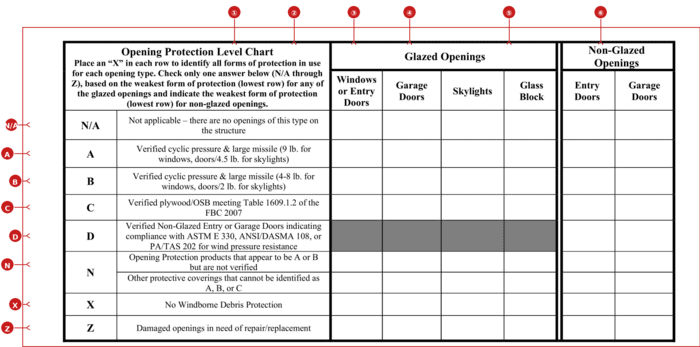
The Opening Protection Level Chart is a grid that the inspector fills in for each type of opening on the home. The columns represent the six categories of openings the form tracks:
- Column ① — Windows or Entry Doors (Glazed): Any window or entry door that contains glass.
- Column ② — Garage Doors (Glazed): Garage doors that contain glass panels or lights.
- Column ③ — Skylights: Any skylight in the roof or wall of the structure.
- Column ④ — Glass Block: Glass block installations used in place of standard windows.
- Column ⑤ — Entry Doors (Non-Glazed): Solid entry doors with no glass — wood, fiberglass, or metal panel doors.
- Column ⑥ — Garage Doors (Non-Glazed): Solid garage doors with no glass panels.
The inspector marks an X in every row that applies for each column — identifying all protection types that are present for each opening category. The final answer selected for the glazed openings is based on the weakest level found across all glazed opening types. Non-glazed openings are evaluated separately.
The protection levels on the Wind Mitigation Inspection Report Form are ranked from strongest to weakest, top to bottom. Here is what each row means:
- Row N/A — Not Applicable There are no openings of this type on the structure. For example, a home with no skylights would have N/A checked in the Skylights column.
- Row A — Highest Protection Level Opening protection products that have been verified to withstand cyclic pressure testing and large missile impact — a 9-pound 2×4 projectile for windows and doors, or a 4.5-pound projectile for skylights. This is the highest standard of impact resistance tested under Florida’s protocols and represents the best possible opening protection credit.
- Row B — Second Highest Protection Level Verified cyclic pressure and large missile impact protection, but at a slightly reduced missile weight threshold — 4 to 8 pounds for windows and doors, 2 pounds for skylights. Products meeting this standard still carry meaningful protection and a strong insurance credit.
- Row C — Plywood or OSB Panels Verified plywood or OSB storm panels meeting Table 1609.1.2 of the 2007 Florida Building Code. This is the panel shutter option — not just any piece of plywood a homeowner nails up, but specifically verified panels that meet the dimensional and fastening requirements of the code. When properly installed and documented, qualifying plywood panels are a recognized form of opening protection on this form.
- Row D — Non-Glazed Door Compliance Verified non-glazed entry doors and garage doors that comply with ASTM E 330, ANSI/DASMA 108, or PA/TAS 202 for wind pressure resistance. Notice that this row has gray shading across the glazed opening columns — Row D applies only to non-glazed openings. A solid entry door or garage door that meets these wind pressure standards qualifies for credit under Row D, but this designation does not extend to glazed openings.
- Row N — Unverified or Unidentifiable Protection Two sub-rows fall under N. The first covers products that appear to be A or B level protection but cannot be verified — shutters or impact glass where labels are missing, documentation is unavailable, or the product cannot be confirmed. The second covers other protective coverings that cannot be identified as A, B, or C. Row N means some form of protection is present but it cannot be confirmed to meet a qualifying standard. It results in a reduced credit compared to verified protection.
- Row X — No Protection No windborne debris protection is present on this opening type. No credit is applied.
- Row Z — Damaged Openings One or more openings are damaged and in need of repair or replacement. As noted in the section introduction, the presence of even a single damaged opening results in no opening protection credit for the entire structure — not just for that opening type. Row Z is the most consequential answer on this section for that reason.
Return to the Main “Understanding the Wind Mitigation Inspection Form” Page
Are you ready for your inspection? Get a Free Online Wind Mitigation Inspection Estimate in Less Than 10 Minutes.