Uniform Mitigation Verification Inspection Form OIR-B1-1802 (Rev. 04/26) Adopted by Rule 69O-170.0155, F.A.C. Page 2 & 3 – Section 6 — Roof-to-Wall Attachment
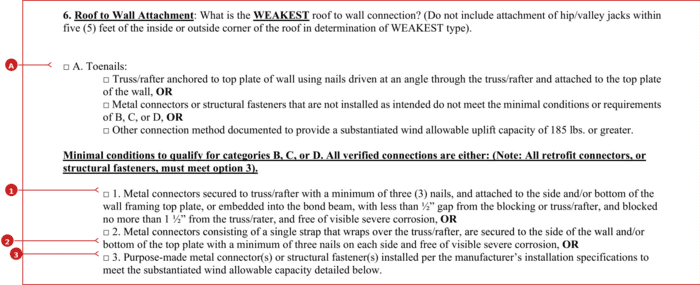
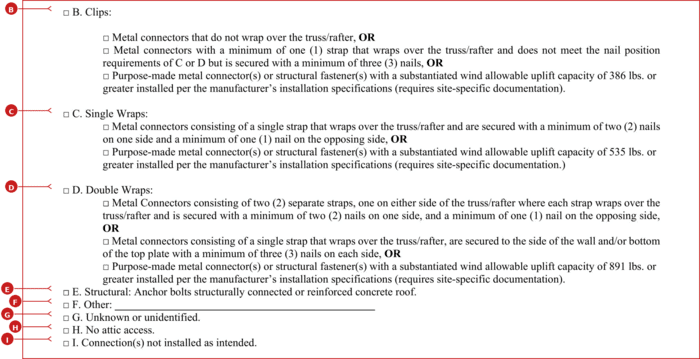
Note: Section 6 spans two pages of the form. The first image above covers the section header, Answer A, and the minimum conditions that apply to Answers B, C, and D. The second image picks up with Answers B through I.
Section 6 — Roof-to-Wall Attachment
Section 6 is, alongside Section 5, one of the two most impactful sections on the entire wind mitigation form from an insurance savings standpoint. It documents how the roof structure — the trusses or rafters — is physically connected to the top of the exterior walls. This connection is what keeps the roof attached to the house when hurricane-force winds create massive uplift forces trying to peel the roof off entirely.
Like Section 5, this section asks for the weakest connection found anywhere on the structure — not the best, not the average. If even one truss has a weaker connection than the rest, that is what gets recorded. The inspector evaluates this from inside the attic, examining the metal connectors or fastening methods visible where each truss or rafter meets the wall’s top plate.
There is also an important exclusion noted at the top of the section: hip and valley jack rafters within five feet of a roof corner are not included in this evaluation. These short framing members at roof corners have inherently different connection geometry, and including them would skew the result unfairly. The inspector evaluates only the main trusses and rafters beyond those corner zones.
The Minimum Conditions — What Qualifies for B, C, or D
Before reaching the answer options B through D, the form establishes a set of minimum conditions that any metal connector must meet in order to qualify for those categories at all. The inspector confirms that connections meet one of three baseline criteria:
- Sub-item 1 — A metal connector secured to the truss or rafter with a minimum of three nails, attached to the side and/or bottom of the wall framing top plate or embedded into the bond beam, with less than ½ inch gap from the blocking or truss, blocked no more than 1½ inches from the truss, and free of visible severe corrosion.
- Sub-item 2 — A single strap that wraps over the truss, secured to the side of the wall and/or bottom of the top plate with a minimum of three nails on each side, and free of visible severe corrosion.
- Sub-item 3 — A purpose-made metal connector or structural fastener installed strictly per the manufacturer’s installation specifications to meet the substantiated wind allowable capacity. This is the required standard for all retrofit connectors or structural fasteners added after original construction.
If the connectors present do not meet at least one of these baseline criteria, the connection cannot be classified as B, C, or D — it defaults to Answer A regardless of what type of hardware is physically present.
The Answer Options
Answer A — Toenails
- The weakest classification. The truss or rafter is attached to the wall’s top plate using nails driven at an angle — a technique called toenailing. This is the most basic form of connection and provides the least resistance to uplift forces. Answer A also covers metal connectors that are present but not properly installed, or that fail to meet the minimum conditions described above. Homes with toenail connections receive little to no credit in this section. Many older homes in Southwest Florida — particularly those built before the mid-1990s — were originally constructed with toenail connections.
Answer B — Clips
- The clip category covers three distinct qualifying scenarios, and this is where the new form gets counterintuitive compared to what longtime homeowners may remember from older wind mitigation reports.
- The first is the traditional clip — a metal connector that attaches to the side or bottom of the truss and the wall top plate without wrapping over the top of the truss at all. These are commonly called hurricane clips or H-clips.
- The second — and this is where the naming stops making obvious sense — is a strap that does wrap over the truss but is secured with only three nails total and does not meet the more demanding nail position requirements of Single Wraps or Double Wraps. In other words, a physically wrapping strap can still be classified as a Clip if it falls short of the higher categories. The physical appearance of the hardware alone no longer tells the whole story.
- The third path is a purpose-made connector or structural fastener with a manufacturer-documented wind allowable uplift capacity of at least 386 lbs., installed per manufacturer specifications and supported by site-specific documentation.
Answer C — Single Wraps
- A metal strap connector that wraps over the truss or rafter and is secured with a minimum of two nails on one side and at least one nail on the opposing side. This nail positioning requirement — nails on both sides of the top plate in specific quantities — is what distinguishes a Single Wrap from the wrapping-strap scenario described under Clips. It is not simply a matter of whether the strap crosses over the truss. A strap that wraps but does not meet this nail placement standard is a Clip, not a Single Wrap.
- The alternative qualifying path is a purpose-made connector with a manufacturer-documented uplift capacity of at least 535 lbs., installed per manufacturer specifications and supported by site-specific documentation.
Answer D — Double Wraps
- The strongest standard metal connector classification on the form. Double Wraps can be achieved through three paths.
- The first is two separate straps — one on each side of the truss — each wrapping over the top and secured with a minimum of two nails on one side and one nail on the opposing side.
- The second is a single strap that wraps over the truss and is secured to the side of the wall and/or bottom of the top plate with a minimum of three nails on each side.
- The third is a purpose-made connector with a manufacturer-documented uplift capacity of at least 891 lbs., installed per manufacturer specifications and supported by site-specific documentation.
- Double Wrap connections provide the highest level of resistance to uplift among the standard strap connector categories and result in the best available insurance credit for this section.
Answer E — Structural Connection
- Anchor bolts or other structural fasteners that create a reinforced concrete or masonry-to-roof structural connection. This applies primarily to certain CBS (concrete block structure) construction where the roof framing is connected directly into a bond beam or reinforced concrete element at the top of the wall.
Answer F — Other
- Used when the connection type does not fit any of the defined categories above. The inspector describes what was found.
Answer G — Unknown or Unidentified
- The attic was accessible but the connection type could not be determined — for example, when foam insulation or other materials obscure the connectors from view.
Answer H — No Attic Access
- The attic could not be accessed and therefore the connections could not be evaluated. As with Section 5, this results in no credit for this section.
Answer I — Connection(s) Not Installed as Intended
- Selected when metal connectors are physically present but have not been installed in accordance with the manufacturer’s specifications or the minimum conditions required by the form. A connector that is there but improperly fastened — wrong number of nails, wrong nail placement, installed backwards, or significantly corroded — does not qualify for credit regardless of what type it is. Answer I specifically flags this condition so the insurance company understands why a credit is not being applied even though hardware is present.
What This Means for SWFL Homeowners
The age of your home has a significant bearing on this section. Homes built in Southwest Florida before the mid-1990s were commonly constructed with toenail connections — it was standard practice at the time. Homes built after Hurricane Andrew in 1992 began to see more stringent connector requirements phased in, and homes built under the 2001 Florida Building Code or later are generally required to have metal connectors meeting a minimum standard.
If your home was built before the mid-1990s and has never had a roof replacement, there is a reasonable possibility it has toenail or minimal clip connections. A roof replacement is often the point at which stronger connectors are installed — though this depends on the contractor, the permit, and what was required under the code at the time of replacement. If you are unsure what type of connections your home has, the wind mitigation inspection will tell you.
A Note on the New Classifications vs. the Old Naming Convention
If you have had a wind mitigation inspection prior to the April 2026 form update, you may notice that the category names on your old report — toenails, clips, single wraps, double wraps — sound familiar but do not quite line up with how the new form defines them. That is because the 2026 revision changed something fundamental about how these categories work.
On the old form, the names were largely descriptive of the physical hardware. A clip was a connector that did not wrap over the truss. A single wrap went over the truss on one side. A double wrap involved two separate wrapping straps. The shape of the hardware more or less told you where it landed on the form.
The new form still uses those same names, but the categories are now defined by a combination of physical description and documented uplift resistance thresholds — 386 lbs. for Clips, 535 lbs. for Single Wraps, 891 lbs. for Double Wraps — with an alternative performance-based path available for purpose-made connectors. This creates situations that feel inconsistent with the names. A strap that physically wraps over the truss can be classified as a Clip if it does not meet the nail positioning requirements of Single Wraps. A purpose-made connector that does not resemble a traditional strap at all can qualify as a Double Wrap if it carries sufficient documented uplift capacity. The name describes a performance tier, not just the physical hardware.
In practical terms this means connectors without documentation may be classified lower than a homeowner expects based on what the hardware looks like, while purpose-made retrofit connectors with proper manufacturer documentation and site-specific records may achieve higher classifications than their appearance alone would suggest. It is one more area where having documentation ready before the inspection can make a meaningful difference in your report outcome.
Return to the Main “Understanding the Wind Mitigation Inspection Form” Page
How much does a wind mitigation inspection cost? Get a Free Estimate Online for your Wind Mitigation Inspection in Less Than 10 Minutes.