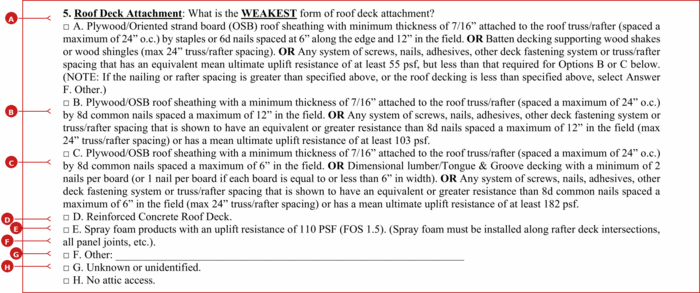
Uniform Mitigation Verification Inspection Form OIR-B1-1802 (Rev. 04/26) Adopted by Rule 69O-170.0155, F.A.C. Page 2 Section 5 — Roof Deck Attachment
Wind Mitigation Inspection Report Section 5 — Roof Deck Attachment
Wind Mitigation Inspection Report Section 5 is one of the most important sections on the entire wind mitigation form, and one of the primary reasons an attic inspection is required. It asks a very specific question — what is the weakest form of roof deck attachment found anywhere on the home?
Before getting into the answer options, it helps to understand what roof deck attachment actually means. The roof deck is the layer of plywood, dimensional lumber, or oriented strand board (OSB) sheathing that is nailed directly to the top of your roof trusses or rafters. It forms the structural surface of the roof — everything above it, including underlayment and the final roof covering, sits on top of it. How well that deck is fastened to the framing below it determines how well the roof holds together when wind forces try to peel it away from the structure.
The form asks for the weakest connection found — not the best, not the average. If even one area of the attic shows a weaker attachment method, that is the answer that gets selected. This is important to understand because it means a home with mostly strong nailing can still receive a lower rating if there is one section with weaker fastening.
The inspector determines the answer by accessing the attic and physically examining the nails or fasteners visible from the underside of the decking. Nail size, nail spacing, and the type of fastener are all documented and photographed as evidence.
Here is what each answer means in plain language:
Answer A — Minimum Standard / Weakest Qualifying Attachment Plywood or OSB sheathing at least 7/16″ thick, fastened with staples or 6d nails spaced no more than 6 inches apart along the edges and 12 inches apart in the field (the interior area between edges), with trusses or rafters no more than 24 inches apart. This is the weakest nailing pattern that still qualifies for a credit. It also covers batten decking used under wood shake or shingle roofs, and any equivalent system with an uplift resistance of at least 55 psf but less than what Answer B requires. If the nailing is wider than specified here — meaning the nails are spaced further apart — the form directs the inspector to Answer F.
Answer B — Stronger Attachment The same plywood or OSB material, but now fastened with 8d common nails spaced no more than 12 inches apart in the field. This represents meaningfully stronger deck attachment than Answer A and carries a better insurance credit. The 8d common nail is larger and has greater withdrawal resistance than a 6d nail or staple, and the tighter field spacing means more fasteners holding the deck down. Equivalent systems with an uplift resistance of at least 103 psf also qualify here.
Answer C — Strongest Wood Deck Attachment The same 7/16″ or thicker plywood or OSB, now fastened with 8d common nails at a tighter 6-inch spacing in the field. This is the strongest nail-fastened wood deck attachment on the form and results in the best insurance credit of the three nailed options. Answer C also includes dimensional lumber or tongue and groove decking with at least two nails per board, and equivalent systems reaching at least 182 psf uplift resistance.
Answer D — Reinforced Concrete Roof Deck A poured concrete structural roof deck. This is less common in residential construction in Southwest Florida but does exist on certain masonry and concrete block homes, particularly older CBS construction. A concrete deck is inherently very strong and typically results in a favorable insurance outcome.
Answer E — Spray Foam* Spray polyurethane foam applied along the rafter and deck intersections and at all panel joints with a documented uplift resistance of 110 PSF at a factor of safety of 1.5. Spray foam has become increasingly popular in Florida as a way to add both insulation and structural performance to the roof assembly simultaneously. When properly installed and documented, it can qualify for a favorable credit under this section. (IMPORTANT: Spray Foam Insulation DOES NOT QUALIFY, see notation below*).
Answer F — Other Used when the deck attachment does not fit any of the defined categories above, or when the nailing or rafter spacing is outside the parameters specified in Answers A through C. The inspector writes in a description of what was found.
Answer G — Unknown or Unidentified The inspector accessed the attic but was unable to determine the type or quality of the deck attachment. This can occur when decking is obscured by insulation, spray foam, or other materials that prevent a clear view of the fasteners.
Answer H — No Attic Access There is no accessible attic space, and therefore the deck attachment cannot be inspected. This answer results in no credit for this section. It is relatively uncommon in Southwest Florida, where most homes have accessible attic space, but it can occur with certain flat roof constructions or homes where attic access has been sealed or permanently blocked. As noted earlier in this guide, a vehicle parked under the garage attic access is one of the more common preventable reasons an inspector may be unable to complete this section.
*Important: Standard Spray Foam Insulation Does Not Qualify
This is one of the most commonly misunderstood points in this section. If you have spray foam insulation in your attic — the kind sprayed across the underside of the roof deck as a thick continuous blanket for energy efficiency — that does not qualify as Answer E. The spray foam that qualifies is a completely different product used in a completely different way. It is a purpose-engineered closed-cell polyurethane foam adhesive applied precisely along the junction where each rafter or truss meets the roof deck and at every seam between deck panels. It must carry a Florida product approval number confirming it has been independently tested to achieve a specific wind uplift resistance rating. Standard spray foam insulation has not been tested for structural wind uplift and carries no such rating regardless of how thick or complete the application is.
To make things more complicated, a full spray foam insulation application can actually prevent the inspector from evaluating deck attachment at all — the nails and fasteners beneath the foam are completely obscured — which can result in an Unknown answer rather than any credit. If a contractor has suggested your spray foam will help your wind mitigation report, ask them for the specific product name, the Florida product approval number, and documentation confirming it was applied for structural wind uplift purposes. Without that documentation, it will not qualify.
Return to the Main “Understanding the Wind Mitigation Inspection Form” Page
Are you looking for a quote? Get a Free Online Wind Mitigation Inspection Estimate in 10 Minutes or Less.